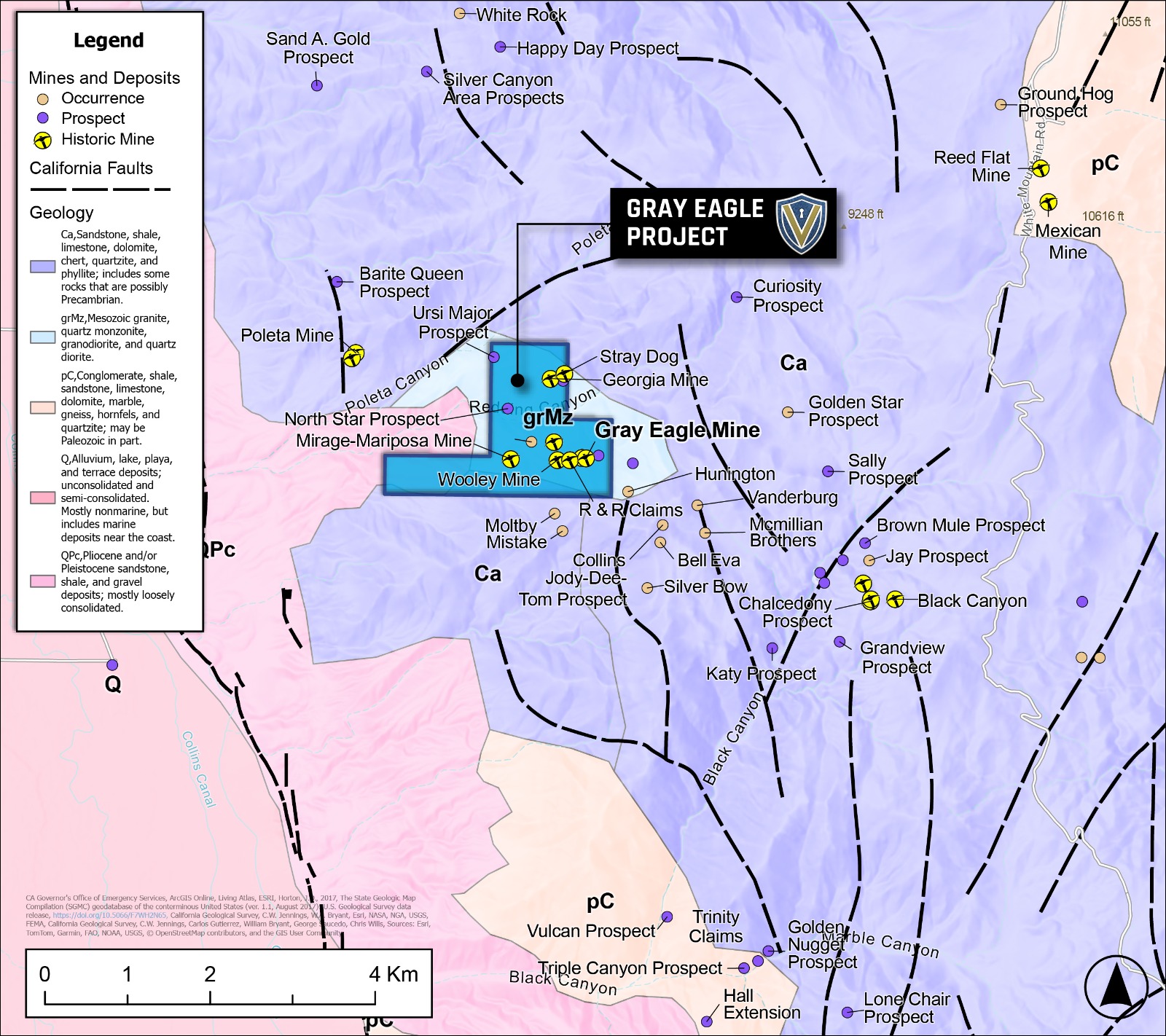
The Mirage-Mariposa Mine is recorded in the U.S. Geological Survey’s (“USGS”) Mineral Resource Data System[1] as a past-producing tungsten and silver site in Inyo County, California. The record identifies tungsten as the primary commodity and silver as a tertiary commodity. The site is also listed under alternate or previous names including the Golden Mirage and Mariposa Claims, Wooley Mine, Black Canyon RARE II Area, and Golden Mirage Mine.
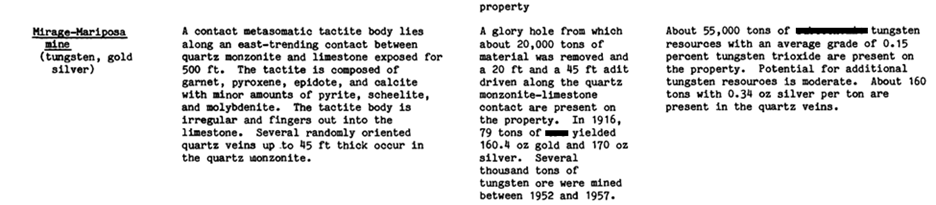
According to the USGS MRDS record, the deposit is associated with replacement-style and disseminated mineralization, with contact metasomatic processes noted as the primary mode of origin. The record describes the primary mineralization control as a contact zone, with intense wallrock alteration and carbonate-silicate alteration. Reported minerals and materials include scheelite, garnet, epidote, quartz, and argentite.
The USGS record describes the Mirage-Mariposa as having historical resources of approximately 21,000 indicated tons and 34,400 inferred tons, with an average grade of 0.15% tungsten trioxide. The record also describes historical underground and surface-related workings, including a shaft in the ‘glory hole’ reported to be 17 feet deep, a 40-foot-wide ‘glory hole’, and approximately 70 feet between the west end of the underground workings at the shaft and the headwall.
The historical resource discussion divided the mineralized area into blocks. Block 1 was reported to contain approximately 5,300 tons of indicated subeconomic resources. By extending the strike length 37 feet to the southeast, an additional 15,800 tons of indicated subeconomic resources were calculated as Block 2. Two inferred blocks were also calculated: the first comprising approximately 11,500 tons by extending Block 1 37 feet below the shaft, and the second comprising approximately 22,600 tons by extending Block 2 an additional 53 feet along strike.
The USGS MRDS record references several historical publications, including California State Mining Bureau reporting from 1894, U.S. Geological Survey Professional Paper 110 from 1918, Knopf’s 1912 USGS Bulletin 540, Bateman’s 1956 report on the economic geology of the Bishop tungsten district, and a 1983 U.S. Bureau of Mines mineral investigation of the Black Canyon RARE II Area.